Translate

Total Pageviews

Showing posts with label Desserts. Show all posts

Tuesday, April 17, 2012

berry roulade


This is pretty much a fool proof way to make a roulade but watch your oven temperature does not exceed 17OC. You don't want the meringue to brown too quickly. Overcooking the meringue gives a brittle result causing cracks to appear once rolled.

Serves: 6-8

Ingredients for roulade:

6 egg whites
1.25 cups caster sugar
1 tablespoon cornflour
1 teaspoon lemon juice
2 tablespoons icing sugar
2 tablespoons unsweetened cocoa powder

Ingredients for filling:

1 cup double cream
2 punnets of berries: blueberries, raspberries
2 tablespoons grated dark chocolate


Method for roulade:

Preheat the over to 170C. Line a Swiss-roll pan with buttered baking paper.

Beat the egg whites with an electric mixer on high speed until soft peaks form. Gradually add half the caster sugar then beat in the remaining caster sugar until stiff, glossy peaks form. Fold in the cornflour and lemon juice.

Spread the meringue evenly in the prepared pan. Bake for 20 minutes or until pale golden, allow to cool for 1 hour. Place another sheet of baking paper the same size on the work surface and dust with icing sugar and cocoa powder. Turn the meringue onto the baking paper. Carefully remove the top sheet of paper.

For the filling:

Beat the cream until soft peaks form. Spread the cream over the meringue. Evenly place the fruit on the cream and grate the chocolate over the top.

Use the paper to help roll up the meringue from the short end. Once rolled, dust with a little extra icing sugar. Ease the roulade, seam side down, onto a serving dish and refrigerate for one hour or until ready to serve in thick slices.

Thursday, March 22, 2012

berry timbale with passionfruit coulis


This is lovely fresh dessert, easy to make with an impressive result. The following recipe makes 6 x 125ml (half cup) capacity dariole moulds. I use Queen's (chocolate) Writing Fudge to seal in the coulis. You could, if you are proficient at making a paper piping bag, with a very fine nozzle, melt down a small chocolate bar instead. Cold plates are essential for serving.

Ingredients:

125g fresh raspberries
250g fresh blueberries

Orange Jelly ingredients:

300ml orange juice (strained) - zest reserved to candy
100ml clear apple juice
6 gelatin leaves or 1 tablespoon edible gelatin powder slacked in 100ml water (sets 400ml liquid, including the 100ml used to slacken)
20ml Grand Marnier liquor
50g sugar

Method:

Soften the gelatin leaves in cold water and squeeze out excess or slacken powder in water as above.

Place everything in a small saucepan except the Grand Marnier, boil for 1 minute.
Remove from heat, add Grand Marnier and set aside to cool.

Fill the Dariole moulds to the top with layers of berries and pour over the jelly. Place in fridge until set, cover with cling film, setting time is several hours or overnight if preferred.

Passionfruit Coulis:

4 medium size passionfruit
1 orange, juiced (zest reserved to candy)
40g icing sugar
25ml water (extra may be needed later for thinning purposes)

Method:

Boil for 2-3 minutes and strain. Add a drop more water if the coulis is too thick. Set aside in a squeezy bottle or small jug

Candid Orange Zest:

Blanch zested peel in boiling water from cold water starts and refresh in cold water. Repeat three times. This takes away the bitterness while softening the zest at the same time.

Method &Ingredients:

Place zest in a small saucepan with 1 tablespoon sugar, 30ml water, 1 tablespoon liquid glucose. Cook for 3 minutes until transparent. Strain and set aside.

Note: the zested peel of a lime could be added for colour

To Serve:

Draw a nice design of your choice with the writing fudge, fill in the centre with the coulis. Upturn the dariole moulds (briefly run the bottom of each one under a very hot tap to release). Place the candid peel on top of the moulds and dust a little sieved icing sugar.


Note: the peel is not visible in the photograph, sorry!

Monday, October 25, 2010

tamarillos with star anise

There is nobody quite like Peter Gordon, the New Zealand chef, for my money. With restaurants in London and Auckland, he is a class act and it was at his Sugar Club in London I first enjoyed tamarillos in red wine.

The following is an adaptation of his famous recipe. Sadly, the season for this beautiful fruit is short so snap them up when you spot them. The sauce is heavenly and if there is any over, I refer to it as ‘the mother sauce’.  Ready and waiting in the refrigerator, it is divine on ice cream or just poured over anything that needs sweetening up.

Ingredients:

6 tamarillos
750ml red wine
200g demerara sugar
2 star anise
1 cinnamon stick
1-2 drops rosewater

Method:

Bring the wine, sugar, star anise, rosewater and cinnamon to the boil in a medium saucepan. Lightly cut the pointed end of the tamarillos with a sharp knife to make an X and place them in the boiling liquid. Return to the boil, reduce the heat to a simmer and cook for 15 minutes – test fruit is cooked with a skewer. Leave to cool in the liquid. Use any way you like – as it, at room temperature of cold from the fridge. Fabulous with vanilla bavarois.

Tamarillos in red wine and star anise printer friendly recipe click this link:

https://sites.google.com/site/foodvineprintablerecipes/home/tamarillos-with-star-anise

Thursday, September 9, 2010

Bonnet


This is the delicious dessert, Bonnet, from the Hotel Villa Rita www.villarita.it on the island of Elba. I'm posting the recipe as it came to me from their chef, Vincenzo.

Preheat oven to 160C
Serves: 10

Ingredients:

6 eggs
100g white sugar
1-tablespoon cocoa powder
125m1-cup filter coffee
125ml Amaretto liqueur
350g caster sugar and 4 tablespoons water to make up a caramel
Amaretti biscuits to garnish
 10 ramekins, greased

Method:

Combine all the above ingredients.  Make up the caramel by placing the sugar in a heavy based pan and slowly melt and cook until it turns a golden honey colour. Remove from the heat and very carefully add 4 tablespoons water. Stir and pour a little caramel into the bottom of each ramekin. Pour in the rest of the mixture.

Place the ramekins in an oven proof dish lined with a tea towel and pour enough boiling water to come half way up the sides of the ramekins. Cook for one hour or until set. Remove and chill under ready to serve.

Unmould each ramekin and turn upside down on individual serving plates. Scatter a little crushed Amaretti biscuits over the top and serve with fresh cream or ice cream.

 Click this link for a printer friendly version of this recipe:

Monday, April 5, 2010

Chocolate Puddings

Like molten lava, hot liquid chocolate spills from the heart of these delicious and versatile little puddings. I sometimes serve them at room temperature just on their own with a creamy cup of espresso or hot for dessert with ice cream or thick fresh cream. They are easy to make up but a very good understanding of your oven is essential so as not to overcook them.

Serves: 5 X 175ml dariole moulds

Ingredients:

140g unsalted butter
140g chocolate, roughly chopped
3 eggs
3 egg yolks
85g castor sugar
25g plain flour

Method:

Preheat the oven to 180˚C. Butter or almond oil the dariole moulds and place them on a baking tray lined with baking paper.

Microwave the butter and chocolate in a heatproof bowl on high for 1 minute 15 seconds until melted. Stir half way through and again at the end of the cooking time. Set aside. If you do not have a microwave, melt the butter and chocolate in a heatproof dish set over a saucepan of gently simmering water. Do not allow the water to touch the base of the dish. Set aside.

Whisk the eggs, yolks and sugar together with an electric hand whisk for three minutes until pale. Stir in the chocolate mixture and whisk in briefly using the hand mixer.
Fold in the flour and pour the mixture into the moulds.

Ovens vary so bake for 12 minutes, check and if necessary bake another 3-4 minutes until risen but still flat on top and not quite firm. The puddings must not overcook.  Loosen the edges with a knife, turn out immediately and serve upright.

Thursday, April 1, 2010

Pashka time, again....


Just to remind you of my Happy Easter favourite from last year but with very good reason. Pashka is just too delicious not to make. Don't be confused by the spelling - it could be: paskha, pashka or paska - but always pronounced pahs-kak. This dish is a classic from Russia and is traditionally decorated with nuts and sweets to form the letters XB which stands for 'Christ is risen'.


Serves: 6-8

Ingredients:

500g fresh cream cheese or ricotta from the deli counter
125g butter
155g caster sugar
300ml sour cream
185g slivered almonds
125g mixed peel, chopped
375g raisins

Method:

Cream the butter and sugar together until pale and fluffy. Rub cheese through a nylon sieve and blend with the butter and sugar. Add sour cream and almonds. Beat well to combine. Add mixed peel, nuts and raisins – stir them through gently but thoroughly.

Line a mould or a flowerpot with a clean chux or j-cloth or muslin big enough to overlap the sides. Fill the pot with the mixture then bring the excess cloth over to cover the top. Weigh down with a saucer and a tin or two and leave in the fridge for at least 24 hours but up to a week is fine. 

Tuesday, March 16, 2010

glazed pears

These quick and easy glazed pears make an outstanding dessert in no time at all. Served hot or cold, alone or with chilled cream or ice-cream they are simply delicious.

Serves: 6

Ingredients:

250g raw castor sugar

250ml dessert wine or sweet table wine

165ml water

1 vanilla bean split and scrapped

3 pears, halved and cored with a melon baller

Method:

Place all the above ingredients, expect the pears, in a wide pot and heat gently on medium - stir until the sugar dissolves. Add the pears, cut side down, cover with baking paper and a weight and simmer until tender – about 15-20 minutes. Set aside in the syrup. Just prior to serving place the pan back on the heat and cook on a very high flame until the sauce caramalises. Remove the pears carefully from the syrup and gently place one on each plate, pour over any remaining syrup. A sprinkling of icing sugar adds a nice touch to the finished dish.

Saturday, November 14, 2009

a rush in red......

Unexpected guests! Fortunately I had a lovely French tart in the fridge and a packet of raspberries in the freezer so I simply cut circles in the tart with a round pastry cutter for each person. I then made quite a thick raspberry coulis. The trick with making a coulis is to use frozen raspberries but do not thaw them. Add a couple of tablespoons of icing sugar - add a little more or less depending on the thickness you require. For the above dessert the coulis must not be too thin. Heat the sugar and berries until the sugar melts then sieve it and pour it into a squeezy bottle for easy application. Queens make a black writing gel available from baking sections in supermarkets. Make a design of your choice with the gel and carefully add the coulis letting the nozzle of the squeezy bottle be your guide. The gel prevents the coulis running out. Place a piece of tart on the side. An almost instant dessert and the day, saved!

Thursday, November 12, 2009

Clafoutis aux Cerises

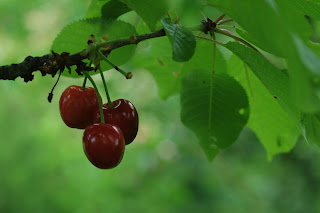
Cherry season is around the corner so no better time to post my clafoutis recipe with this lovely photograph taken by our friend, Stewart, in France this summer. Cherries herald Christmas, sent by the Gods to tantalize our taste buds and senses in readiness for feasting and merrymaking. Their symbolic red, their bell shape and their vivid image in overflowing bowls on the Christmas table next to piles of whole nuts completes our Australian dream of 25th.

Cherries also remind me of black and white photographs of my mother when she was in her early twenties, looking so glamorous in khaki overalls, picking cherries in Young, when she was a volunteer in the Australian women’s land army during war 2. A place where there are so many cherry trees if you picked just one cherry off each tree the quantity would be impossible to eat.

The first time I made this dish was at the Cordon Bleu school. We had had several weeks of non-stop pastry making and I couldn’t wait for this section of the course to end. I’m not one for pastry making but I was quite proud of my efforts with the clafoutis and really wanted to get it home safely. Juggling keys, books, toolbox, uniform and clafoutis I managed to drop my prized pie at the front door where it landed, very neatly, upside down. Inedible to say the least!

I have included a recipe for sweet pastry (pâte sucrée) but a base is not necessarily required. To speed things up just butter an ovenproof dish, scatter over the cherries and pour the batter on top. My way, using the pastry, is more time consuming but great if you want to turn out the pie to present it whole on another plate. Traditionally served with Crème Anglaise but pouring cream or ice-cream would be just as good. Some stone their cherries, some do not and some use sweet varieties while others use sour. It’s all a question of personal choice.

Ingredients:

For the pastry, if you are one of those clever people who make their own:

(250g Sucree pastry)
125g unsalted butter
90g caster sugar
1 egg
250g plain flour

Cream the butter and sugar. Add the egg. Sieve and mix in the flour to form a smooth dough. Refrigerate for thirty minutes.

600g cherries, pitted, washed and carefully dried with kitchen paper
20g butter to grease the pie dish
Icing sugar to serve

For the batter:

50g plain flour
3 eggs, 2 whole plus 1 yolk
200ml milk
Pinch salt
25ml honey
30ml Kirsch

Method:

Make the pastry first and place it in the refrigerator for 30 minutes as stated above. The pasty must be made first because it needs three resting periods. Lightly grease a 20cm flan tin with the butter. Roll out the pastry 2mm thick, line the tin and rest the pastry in the refrigerator for another 30 minutes. Do not prick the base, as the filling will leak. Fill with baking beads and bake at 175C for 15-20 minutes. Glaze with a little egg wash and return to the oven for 5 minutes. Rest again for another 30 minutes.

To make the batter: sift the flour and salt into a basin and make a small bay. Add the eggs and half the milk. Whisk to a smooth batter. Warm the rest of the milk in a small saucepan and add the honey, stir until dissolved and add to the batter then add the Kirsch. Strain the batter and allow to rest one hour.

Place the cherries in the cooked pastry case and fill with batter to within 3mm from the top. Bake at 175C for 30 – 45 minutes or until well risen and brown. Use a skewer to make sure the batter is cooked through.

Remove from the oven, unmould, dredge with icing sugar.

Wednesday, October 28, 2009

Glazed Fruit Tarts


Fruit tarts make quick, delicious and economical desserts – it is amazing just how far one or two apples can go! Use any fruit in season and glaze them with either apricot jam or redcurrant jelly. Add a little alcohol to apricot glaze like grand marnier, cointreau or brandy and reduced red wine to redcurrant jelly.

I am a sucker for redcurrant jelly with red wine and the marriage of this with pears is just about as good as it gets. I do not bother too much about measurements as you will see below and I buy the puff pastry. I make sure I always have a good supply in the freezer.

Buy pears ready to slice otherwise buy hard pears and cook them in the red wine during the reduction process.
Ingredients:

1 x 375gm block of frozen puff pastry
3 pears
1 bottle full bodied red wine
1 cinnamon stick, 2-3 cloves optional
300gm jar redcurrant jelly

Method:
Preheat oven: 180C

Grease a tart tin, roll out the pastry, and place the pasty in the tin, use a fork to prick a continuous line about half an inch in from the edge all the way around the pastry. Place the tin in the fridge for half an hour. Pour the red wine into a medium sized saucepan, add spices if using and the pears if necessary and cook until the pears are soft. Remove the pears and the spices and keep reducing the wine until there is about 2 Tablespoons left. When the pears are cool enough, if they needed cooking, slice and arrange overlapping each other on top of the pastry.

Brush the visible edge of the pastry with a little milk or cream and bake in the oven for about 30 minutes until the pastry is brown and cooked. Remove and cool.

Add the redcurrant jelly to the wine and reheat until it has melted. Brush the glaze all over the tart using it all up. Leave until the glaze has thickened – about ten minutes and serve, sliced in large squares with a big bowl of thick fresh cream or ice cream. The addition of fresh red currants, dipped in egg white and dusted with icing sugar, scattered over the top of the tart looks stunning.

For apricot glaze, excellent with apples and fresh apricots, buy a jar of apricot jam fruit free. If you can only find jam with fruit pieces in it then strain them out. Heat the jam gently, add a splash of your chosen complimentary alcohol then brush the hot glaze over the cooked tart. Toasted almonds scattered over the top add another dimension.

Saturday, October 3, 2009

making the most of citrus

Our orchard is heavy with blood oranges, lemons, limes and orange blossom - all crying out to be picked and dealt with in some fancy way. Not wanting to miss this opportunity I made up the following: Two bottles of limoncello two batches of glazed limes and blood oranges and 750ml of orange blossom cordial. I also zested and juiced a lot of excess fruit and froze it in ice-block trays for that rainy day when the fruit is scarce and the heady perfume of our orchard can come flooding back to me.

It really is a good idea to juice excess citrus. If you don't have an orchard buy lots when it's cheap this saves time by guaranteeing measurement and gives you a plentiful supply at any given moment. My ice-block trays hold 30ml a slot speeding up cooking times for future recipes. Blood oranges only have a very short season and are so worth capitalizing on in this time frame. There is nothing quite like their taste and flavour. I freeze all citrus zest but I blanch it three times from cold water starts before doing so. This takes away the bitter taste while softening it at the same time. Once the contents of the trays are frozen either wrap them in cling film or remove the blocks and place them in plastic bags for easier storage.
Glazed Blood Oranges
250ml water
250ml granulated sugar
6-8 medium sizd blood oranges
Use a 30cm (12 inch) frying pan and melt the sugar and water slowly over a low heat. Stir until boiling point then lower heat to a simmer and add the fruit, carefully. Don't worry about the pips and take the risk of damaging the fruit - they pop out during the cooking and can be removed with tongs - if you miss a few it doesn't matter. Cook until the fruit is sticky and the liquid has almost evaporated. Allow to cool and place each slice carefully into an airtight container and refrigerate. Substitute: limes but use about 10. Use either glazed fruit as a garnish for desserts, sliced pates or in drinks.
Orange Blossom Cordial (if this link breaks use the search option above)
In addition to my previously published recipe I strained the cordial and flowers through muslin before pouring into the sterilize bottle. I used 2 cups of sugar and 2 cups of water and it was quite tart. Add a little more sugar if you have a sweet tooth. Delicious either way. I only had borage flowers for my ice-blocks - multicoloured edible flowers look wonderful. Yield this time: 700ml

Tuesday, July 28, 2009

Maggie's Chocolate Pavlova with Raspberries

We were very happy to be invited to lunch recently at the home of our good friends, Maggie and George and eagerly awaited the day knowing Maggie would cook up a tornedo. The following is the dessert we were served - an absolutely stunning chocolate pavlova with lashings of mascapone, creme fraiche and plump raspberries. The meringue was indeed superb - all crispy on the outside and perfectly chewy on the inside and her cleverly combined filling gave the pavlova a new dimension and taste sensation. We were treated to something really special.

Serves: 8 - 10

Oven: 180C

Ingredients:

6 egg whites
300g castor sugar
3 tablesppons cocoa powder, sieved
1 teaspoon red wine vinegar
50g chopped dark chocolate.

Topping:

250g creme fraiche
250g mascapone
500g fresh raspberries
2-3 tablespoons shaved chocolate

Method:

Line a tray with baking paper. Beat eggs whites until they stand up then beat in the sugar, 1 tablespoon at a time. Test for firmness by turn the basin upside down - the meringue should not drop out. Add the cocoa and chocolate and gentle fold into the whites.

Mould the meringue onto the paper and form it into a round to about 22 cms.

Turn to the oven down to 150C and cook the meringue for 1 - 1.5 hours. Turn the oven off and leave the door ajar and let the meringue cool completely. Whip the creme fraiche and mascapone and pile on top of the meringue, top with raspberries and shave a little more chocolate over the top.

Friday, April 10, 2009

Qunice time............

One of the best things about Autumn is the great misunderstood quince and the best thing about quinces is the heavenly aroma in the kitchen during the cooking process. I'm not all that crazy about preparing them - maybe I'm just not strong enough to cut and peel. Some say don't peel but I think they look better on the dessert plate if they are. I make them one way only:

Slice, core and peel three or four large quinces. Grease a shallow oven proof dish - lay the pieces side by side and drizzle over a couple of tablespoons honey and about 150 ml water and a few knobs of butter. Cook at about 150C for two to three hours. Test for doneness with a skewer and turn regularly. Their colour will change to a soft rosy pink and they will smell divine.

Thursday, April 9, 2009

HAPPY EASTER!

With Easter upon us Paska comes to mind. Many dishes are synonymous with Easter but this is the one I try very hard not to forget and Al is a huge fan so it is a must do for me. Paska has its origins in Russia and is traditionally made in a flowerpot to resemble the Turkish hat or captured Turk’s head, as it is known. This recipe came to me a very long time ago from my great old friend, Annie, when I lived in London. We cooked together often, swapped many recipes and talked food until we were blue in the face. Every year I make Paska and think of her, our cooking and our laughing. Other recipes call for eggs but I think this is nicer and gets top points for ease.

Serves: 6-8

Ingredients:

500g fresh cream cheese or ricotta from the deli counter
125g butter
155g caster sugar
300ml sour cream
185g slivered almonds
125g mixed peel, chopped
375g raisins

Method:

Cream the butter and sugar together until pale and fluffy. Rub cheese through a nylon sieve and blend with the butter and sugar. Add sour cream and almonds. Beat well to combine. Add mixed peel, nuts and raisins – stir them through gently but thoroughly.

Line a mould or a flowerpot with a clean chux or j-cloth or muslin big enough to overlap the sides. Fill the pot with the mixture then bring the excess cloth over to cover the top. Weigh down with a saucer and a heavy tin or two and leave in the fridge for at least 24 hours - up to a week is fine. Invert pudding onto a serving plate and remove cloth. This pudding is very rich so serve small portions and keep the rest for later.

Monday, March 30, 2009

Summer Pudding


Summer Pudding is so English and so delicious!

It might be autumn here officially but I am sneaking in this recipe while we still have a little summer weather left. I like to make individual summer puddings but they are very filling - one large pudding makes more sense and is more economical for leftovers but not so impressive in the looks department. I have not given a quantity for bread – it will depend on your bowl size but around twenty slices will probably be a good guide for a medium size pudding. I sometimes use fresh bread and sometimes stale – they both work well.

Serves: 4

Ingredients:

600g frozen mixed berries
110g caster sugar
100ml water
Enough white sliced bread to line bowl, crusts removed
Cream to serve

Method:

Place the frozen fruit in a medium size pan with sugar and water, slowly bring to the boil over low heat and simmer for 4 minutes until the sugar dissolves. Remove from the heat and let it rest for 15 minutes before you assemble the pudding.

Grease a large bowl or four individual ramekins with a little butter. Cut enough bread to line bottom of bowl/s, the sides, a layer for the middle and a layer for the top. Start by lining the bottom of the bowl and the sides. Using a slotted spoon, half fill the bowl with berries, add extra bread to fill the middle, continue with more berries and finally, add more bread to cover the top of the pudding. Pour over the rest of the juice but reserve about two tablespoons for ‘patching’, later. Weigh down the pudding with a plate and a couple of cans and chill overnight or for at least 6 hours in the refrigerator. Turn the pudding out of the bowl and ‘patch’ up any white spots with the reserved juice. Serve with cream and blue rosemary flowers scattered over the top.


Wednesday, March 25, 2009

Watermelon Granita with Ginger Syrup

This is a good palate cleanser between courses or served as a dessert – both are ideal as part of an Asian meal. The combination of icy watermelon, fresh ginger and just a tiny hint of rosemary from the everlasting flowers are heavenly. So far it’s my favourite thing in 2009 all thanks to Neil Perry from whose original recipe I have adapted this.

Serves: 6

Ingredients:

750g seedless watermelon, coarsely chopped for the granita
200g watermelon, finely diced for the finished dessert
60gm white sugar for the granita
100gm white sugar for the syrup
20gm fresh ginger, coarsely chopped
60ml water
Blue rosemary flowers for garnish

Method:

Roughly chop the melon, place in a bowl and sprinkle over 60gm sugar. Leave to macerate for about an hour then blend until smooth and pass through a very fine sieve. Pour into a 20cm x 30cm shallow metal tray and place in the freezer, stirring and scraping during the course of the next few hours until crystals form and the granita is frozen.

Ginger Syrup: Combine 100gm sugar, ginger and water in a saucepan, stir over medium heat until the sugar dissolves. Bring to the boil, turn off the heat and stand until cool. Strain, discard the ginger pieces and refrigerate the syrup until it is completely chilled.

To serve:

Divide the diced melon into martini glasses, top with granita, drizzle with syrup and scatter blue rosemary flowers over the top.

Saturday, March 21, 2009

Persimmon Sorbet


harvest fresh persimmons (now in season in Oz), wash them carefully, pat dry and freeze to rock hard. Remove fruit from the freezer about fifteen minutes before serving, slice in half and enjoy naturer's sorbet!

Friday, February 13, 2009

Bavarois with Fresh Figs


The right kind of yoghurt is the secret key to these melt in the mouth Bavarois. This is an adaptation of a Peter Gordon recipe from the Sugar Club, London. I am a huge fan of his and have been fortunate to experience two of his restaurants: Sugar Club (now closed) and Dine in Auckland. Peter is also at The Providores and Tapa Room, London.

Serves: 6

Ingredients:

100ml double cream
1 vanilla pod, seeds only
150g caster sugar
4 leaves gelatin leaves, softened in cold water for 4-5 minutes
300ml yoghurt – rich Greek (not Onassis) or equivalent
175ml double cream, lightly whipped
Served with fresh figs and orange blossom honey

Equipment: 6 dariole moulds slightly greased with almond oil

Method:

Bring 100ml cream, sugar and vanilla to the boil. Remove from the heat, add softened gelatin, stir until dissolved, allow to cool. Add yoghurt and whipped cream. Pour into moulds and refrigerate overnight. Grate a little orange over the top for special effect and serve with any fresh fruit and honey.


Sunday, January 4, 2009

Glazed Mango with Mascarpone, Grand Marnier & Raspberry Coulis

I made this dessert over two days, taking the stress out of last minute preparation. It might look complex but it is very simple. Just follow these easy steps and you can't go wrong!

Serves: 4

Ingredients:

Almond oil for greasing ring moulds or pastry cutters
1 large mango, thinly sliced
4 savoiardi biscuits, each broken into four pieces
2 tablespoons Grand Marnier
4 tablespoons icing sugar
3 red currant sprigs
White part 1 fresh egg
Mint leaves for garnish
Icing sugar to dust, sifted
8 marinated baby figs (optional)

Method:

Very lightly grease 4 ring moulds with almond oil
Mix together mascarpone, double cream, 3 tablespoons icing sugar and vanilla
Break each savoiardi biscuit into four, soak in Grand Marnier five minutes
Mix raspberries, 2 tablespoons icing sugar, sieve, and pour into a squeezy bottle

To make up:

Place each ring on a serving plate. Put a little of the mascarpone cream inside the ring, add 4 pieces of biscuit to each ring, top up with more mascarpone and place in fridge overnight.

Following day:

Very carefully, un-mould each ring and spread any leftover mascarpone around the sides. Heat a spatula with hot water and smooth all visible sides. Place 3-4 mago slices on top of each dessert. Heat apricot jam and glaze mango. Return to the fridge.

Just before serving:

Create a barrier by drawing a circle on each plate with writing ink – this prevents the coulis from spreading over the plate. Fill the inside space with raspberry coulis using the squeezy bottle or carefully spoon it into the circle. Dip red currants into egg white and dust with icing sugar and place on top of each dessert. Garnish with mint sprigs and dust with more sifted icing sugar.

I had some marinated baby figs in the fridge so I added these for extra flavour and colour but they are not necessary!

ENJOY!


* A note about glazing:

When using apricot jam as a glaze – do not use conventional jam containing fruit pieces. Apricot jelly or apricot jam that is clear; i.e. fruit free works best. Brush the mango pieces immediately while the glaze is hot, if left to cool, even for a few minutes, the glaze will cloud!

* partly inspired by Belinda Jeffery's mango cake published in her book 100 Favourite Recipes


Thursday, December 4, 2008

Baked pears in Sangiovese and Caramel

I often find myself wondering what to make for dessert and think by going shopping inspiration will come. I should know by now that usually it doesn't! Having gone about this same old routine year in year out I think it's time I had a better system! I should be able to remember or to check one of my umpteenth lists to remind myself that pears are it!

The beauty of this recipe apart from the magical combination of wine and caramel is its stretch ability factor! If unexpected visitors appear or you just fancy some extras, add another couple of pears to the pot - there always seems to be enough sauce!

I have adapted this from an original recipe published by the River Cafe (Book Two), London.


Preheat oven - 180˚C
Serves: 4-8
Preparation time: Pears 5 minutes - Caramel 15 minutes
Cooking time: 50 minutes

Ingredients:

4-8 cooking pears, any variety in season
4-8 wide pieces lemon zest
Juice 1 lemon
1 vanilla pod or 1 teaspoon vanilla paste
200 ml Sangiovese – or any light red wine

Caramel:

300g caster sugar
120ml water

Method:

Wash pears and slice the bottom off each one, retain storks. Hollow out the cores using an apple corer. Put the vanilla seeds or a little vanilla paste into the cavity of each pear and close opening with lemon zest. Stand pears upright in an oven to table dish. Squeeze over lemon juice, cover with a piece of foil and place in the oven for 10 minutes.

Gently melt the sugar and water in a small saucepan and bring to the boil without stirring. Boil on a low heat for 15 minutes. Critical point: the moment the sugar starts to darken and smells bitter remove it from the heat immediately. Take the saucepan to the sink for safety and add the wine - it will splutter furiously! Pour the caramel over the pears and return pears to the oven for 40 minutes. Baste pears half way through the cooking time. Remove pears from the oven, they will look all shriveled and crinkly and test if cooked with a fine skewer.

Cool pears down before serving. I love them served warm or cold when the caramel has thickened and the flavours have developed. They are quite delicious!

Tip:

Vanilla paste is a new product and is a very good substitute for the real thing!

1 teaspoon = 1 vanilla pod - can’t be bad!