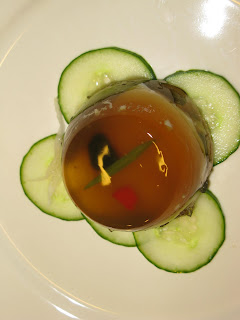
In Oz I buy glace de viande (meat glaze) in jars from David Jones mainly because it's easy and I'm too lazy to make my own. With time on my hands recently and a long way from David Jones I not only wanted to end up with glace de viande but wanted a wobbley (not rubbery) aspic (jelly) in the process. I was determined not to clarify the stock with the aid of egg whites and if it wasn't for the simmer pad on my Lacanche cooker my goose would have been well and truly cooked! So it was with Richard Olney's trusted Simple French Food by my side and a few of my own ideas ready to throw in for good measure I set out on an interesting and successful journey.
Technically, glace de viande is made from a demi glace and demi glace is, more or less, sauce Espagnole. Glace de viande is the result of progressive transferrals of a demi glace to smaller saucepans and continued reduction to the state of a thick syrup and is the consistency of hard rubber. It is one of the sauce-enrichening standbys of classical cuisine. It can be kept, refrigerated, for a very long time. My idea was to by-pass the demi glace and turn the jelly, after using some of it for my aspic eggs, into glace de viande by continual reduction.
Place a rack if you have one in the bottom of your stock pot on which to place the meat and bones and then add the following:
1 veal knuckle (including meaty section) cut in two or three pieces, 2 pig's trotters split in two or 1 calf's foot boiled from a cold water start for 5 minutes, 500g chicken wing-tips, water to cover.
Place the meat and bones onto the rack if using and fill pot with enough water to cover by a good 4 to 5cm. Heat slowly taking about an hour to get to boiling point. Do not start to remove the forming scum until just before boiling when it is very easy to do so. As soon as you skim the first lot of scum off add a glass of cold water to the pot and wait until it almost reaches boiling point again and repeat the process again and again until there is not grey scum visible only a little white froth.
Now add to the pot the following:
1 medium onion stuck with a few cloves, 3 large carrots, peeled, 2 large leeks, cut in 3 - 4 pieces each, 1 stick celery, 1 unpeeled whole garlic bulb and a handful of course salt. Bouquet garni tied in muslin: a few sprigs thyme, 1 bay leaf, few sprigs of parsley
Return the pot to almost boiling point and skim again. Regulate the heat onto the lowest of the low settings and leave the lid ajar. The surface of the stock should be at a murmur - not as cool as true poaching point nor slipping into a full boil. This careful adjustment may take some time until it is precise and consisent. Use an asbestos pad if your cooker is tricky. The stock must be left, undisturbed, for around 9 - 10 hours.
Place a colander over a bowl or another saucepan and line it with several layers of muslin and drain the stock through it. Wash out the muslin and repeat and keep repeating until the stock is completely clear. Cool rapidly, place in the refrigerator overnight, uncovered.
Aspic (jelly) must be as clear as crystal. Remove any traces of fat with a spoon then wipe the surface of the set stock with a piece of muslin that have been boiled and rung out. Put the pot back in the fridge until you are ready to make up the eggs.
600ml of (the jelled) stock melted gently with 3 tablespoons port or sherry, decorative pieces, e.g. leaf of tarragon, half an olive, tiny piece red pepper, 6 very lightly poached eggs: cooled , cut into neat circles and trimmed of excess whites.
Rinse six moulds/ramekins out with cold water. Pour in a tablespoon of stock to just cover the bottom of the mould and add the decorative pieces. Place in refrigerator to set. Add a little more stock, set it, add the eggs but turn them upside down in the moulds so when they are upturned they are the right way up, add a little more stock and set again. Add a slice of ham cut to fit each ramekin, I used jamon Iberico (pata negra) .... as I just happened to have some in the kitchen BECAUSE our good friends from Spain gave us a WHOLE HAM recently - blowing us completely away ........SO I JUST HADE TO USE IT - the most fantastic ham in the world world. Lastly top up the moulds with stock if there is any room left and reset in the refrigerator.
Unmould by running the tip of a knife round the top of each mould, turn upside down and jar against your hand. If they don't budge dip the bottom of the mould in hot water for a brief second then try again. The aspic eggs would be nice served on a bed of small leaves or with a mousse or as I have done, with dressed cucumber rounds.
With my leftover jellied stock every two days I gently reheated it then reduced it for 15 minutes, cooled it rapidly and put it back uncovered in the refrigerator. Now, some time later I have wonderful glace de viande which I am successfully using in other sauces. Voila! I should point that my version is not quite the real thing but it still works and tastes great.


